
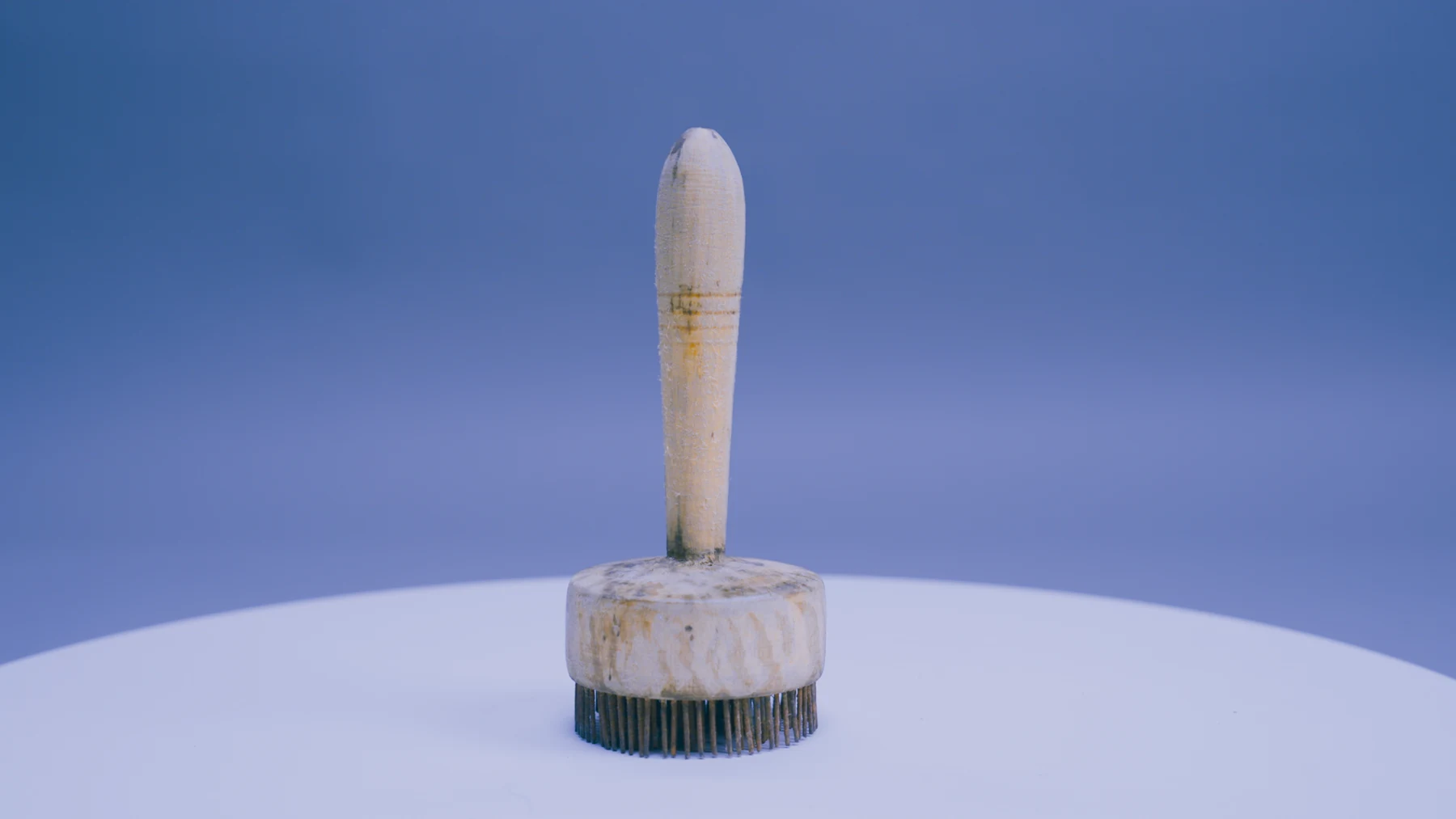
Wooden, round head, metal spikes densely sticking out of the bottom. Chekich looks like a smaller torture device at first rather than a kitchen tool. And it goes into the bread, and the baker puts it in the middle of the pastries before he makes it. The holes and the depressed surface help keep the center low, while the thicker edges rise. During the sample, there can also be an ornament and a visible mark of the bread of a workshop. [1]
On the finished bread, it's easy to see only the flowers or the circle of points. What I'm interested in is the same move that shapes food and its surface. There is no special decoration on it: the tool works with the dough, and even after baking, you can see where it touched it.
What does the baker put in the dough?
Chekich has several transcriptions, you can also see it in the form of chekich, chakich and checkich. The piece in the picture has long wooden juice and a round head with thick metal spikes on the bottom. From the side, we see a line of them; but the bread shows their full prints. The use of the tool makes the form understandable.
If you see the bottom of the tool and the surface of the bread together, you can also follow the motion: where the head was placed, what part it covered, whether it was printed or repeated once. The points of the spikes are going to make the dough a little deep.
There are other forms in the baker's number. In Eric Hansen's taskenti report, the bosma press creates a radial sample on the outside of the bread; the solution presented is made of recycled bicycle spokes. The different traces of bread can therefore come from different instruments. [1]

The flat centre has a purpose
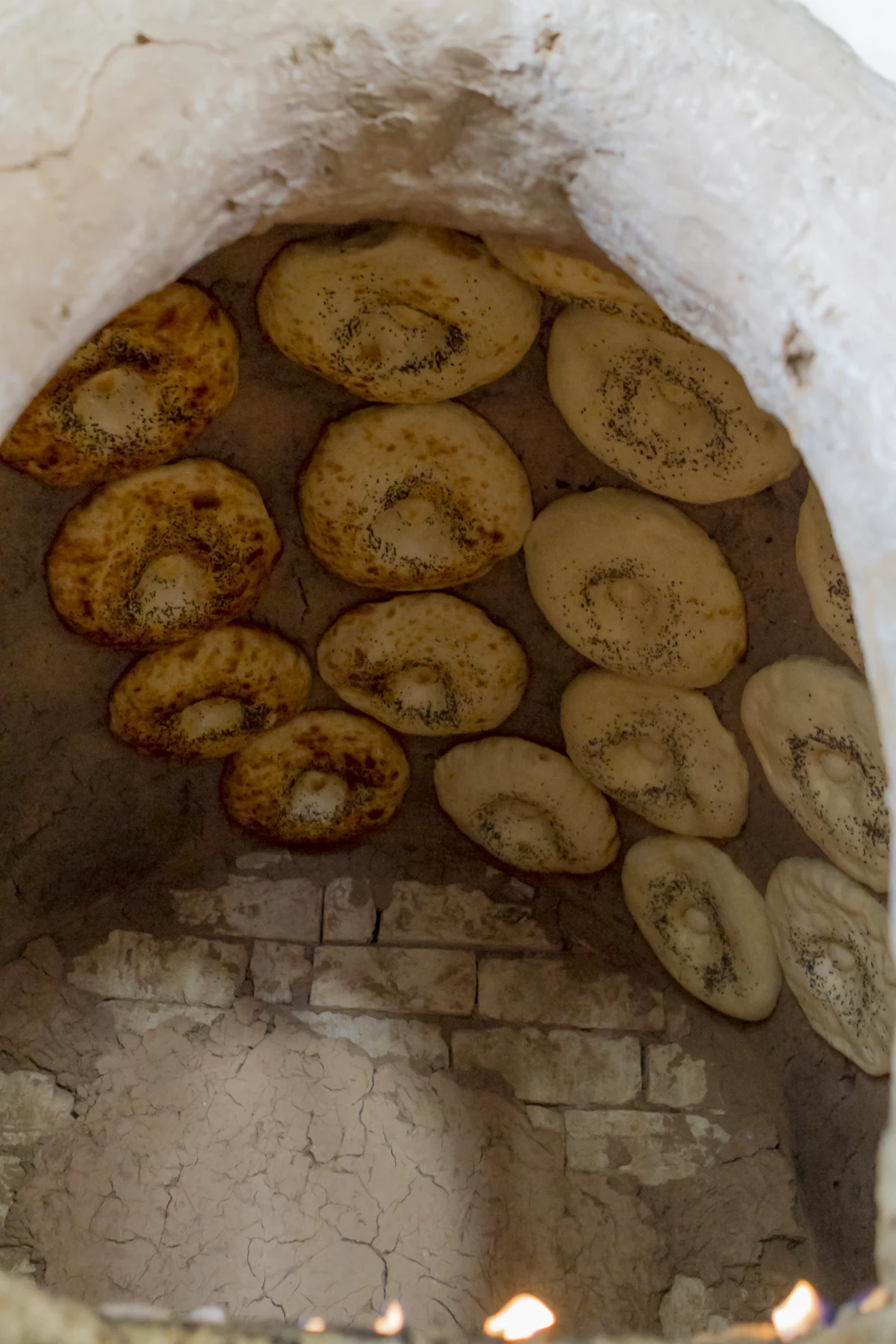
After the perforation and compression, the work continues in the Tandir: the bread is stuck on the inside wall of the furnace. [1] The photo also shows the surface of the bread placed next to each other and the curved oven behind it. The tool itself has barely told us anything about the conditions under which the bread will be made.
In Anita's own Uzbekistan report, the softer, chewier edge and crisp middle of bread appear together. This is a traveler's tasting description, not all bakery product standards, but it draws attention to what is worth comparing. It's more interesting to bite the same bread in two places than to give it a score right away. [2]
That doesn't make the bread of Uzbek ready to buy a seal. The tool performs a working phase. The raw material, the preparation of pasta, the moulding and baking are still a separate task. The beautiful drawing on the stamp itself does not tell you what homemade pasta will do.
One bread pattern does not represent an entire country
The gastronomic summary of the tourist agency also lists several names: non, patyr, shirmoi- non and catlama. [3] This list also shows how little it would be to describe the bakeries of this country on the basis of a single bread.
In the market, I would therefore like to look for differences. How big is the middle part compared to the lawsuit? How dense is the score? Is there a seed on the surface? Did they use one large sample, or did they repeat small traces? These do not require prior knowledge. If there's more bread next to each other, the comparison can start immediately.
However, the decoration would not automatically read religion, family history or hundreds of years of symbolism. If a maker tells you what a motif means to him, it's worth listening carefully. I'd like to connect the explanation to that maker and that play. A nice circle doesn't necessarily involve full cosmology.
This tool has also worked in Hungarian bakery
In 2019, Heim Endre wrote about making Uzbek bread for a plov dinner in Hungary. They were given tools brought back from a professional trip to Uzbekistan. What I like about the account is that it does not start from ready-made expertise: a baker is given an unfamiliar task, examines the tools and gets to work. [4]
This brings the object closer than putting it directly into the category of unattainable craft. Anyone else who has learned to work with pasta can also have a new tool and a new form. Handsome doesn't mean you have to do the same thing for every bread.
In addition, the designation of bread appears in other cultures. In the Metropolitan Museum collection there is a ceramic bread stamp dated to the 10th century linked to Egypt. [5] This alone does not prove any direct link of origin with the Uzbek tool. Rather, it is a good opportunity to compare: what other material and other surfaces can be made of objects for similar tasks?
If you're curious beyond the pattern
I'd ask a baker if he would show me the seal before using it. Between the finished bread and the tool, it takes a few seconds to understand their relationship. Of course, I would like to discuss work and photography first; just because the motion can be photographed doesn't mean I have to repeat it.
I'd like to take a picture of that relationship. A close image of the metal spikes, another of the noodle marked, and then the surface of the same piece. If I just want to show you the symmetry, it could just be an overview. If you're interested in operation, you need to meet hands and pasta.
I'd like to bring home a chewich if I use it. Before that, I'd like to see how stable the spikes are, whether the handle is comfortable, and ask him about his material, his cleaning. During Anita's article, a reader asks about the purchase, reports another rusty. These are individual comments, but they bring the fancy object back to the kitchen quite sober. [2]
Sources and verification
Source verification:
- Eric Hansen: The Fabled Flatbreads of Uzbekistan - AramcoWorld, July 15, 2015 Original bakery and tool maker report; chekich, bosma, shaping and tandir. We have not taken over the distant allegations of historical origin.
- Anita: The art of Uzbek flatbread - Travel report of April 2012, accessible from 2017- 2020. Taste is an individual description; procurement and rust comments are not a general product test.
- Uzbekistan Travel: Gastro tourism - The bread list for the local tourist portal. We don't use your ads and other generalizations as facts.
- Heim Endre: This year we were able to make the Plov- day Uzbek bread - 15 October 2019. Our own bakery report on Hungary, Uzbekistan.
- The Metropolitan Museum of Art: Bread Seal, 27.138.2 - It's a ceramics product dated to the 10th century with a lineage linked to Egypt. Comparison; not evidence of a direct history of chekich.
Research cultural article. Current weighing is a new copyright; the bakeries seen by other authors are not Henrik's memories. We do not give a tested home recipe, and we do not order universal symbol reports for samples. The work of external authors.