
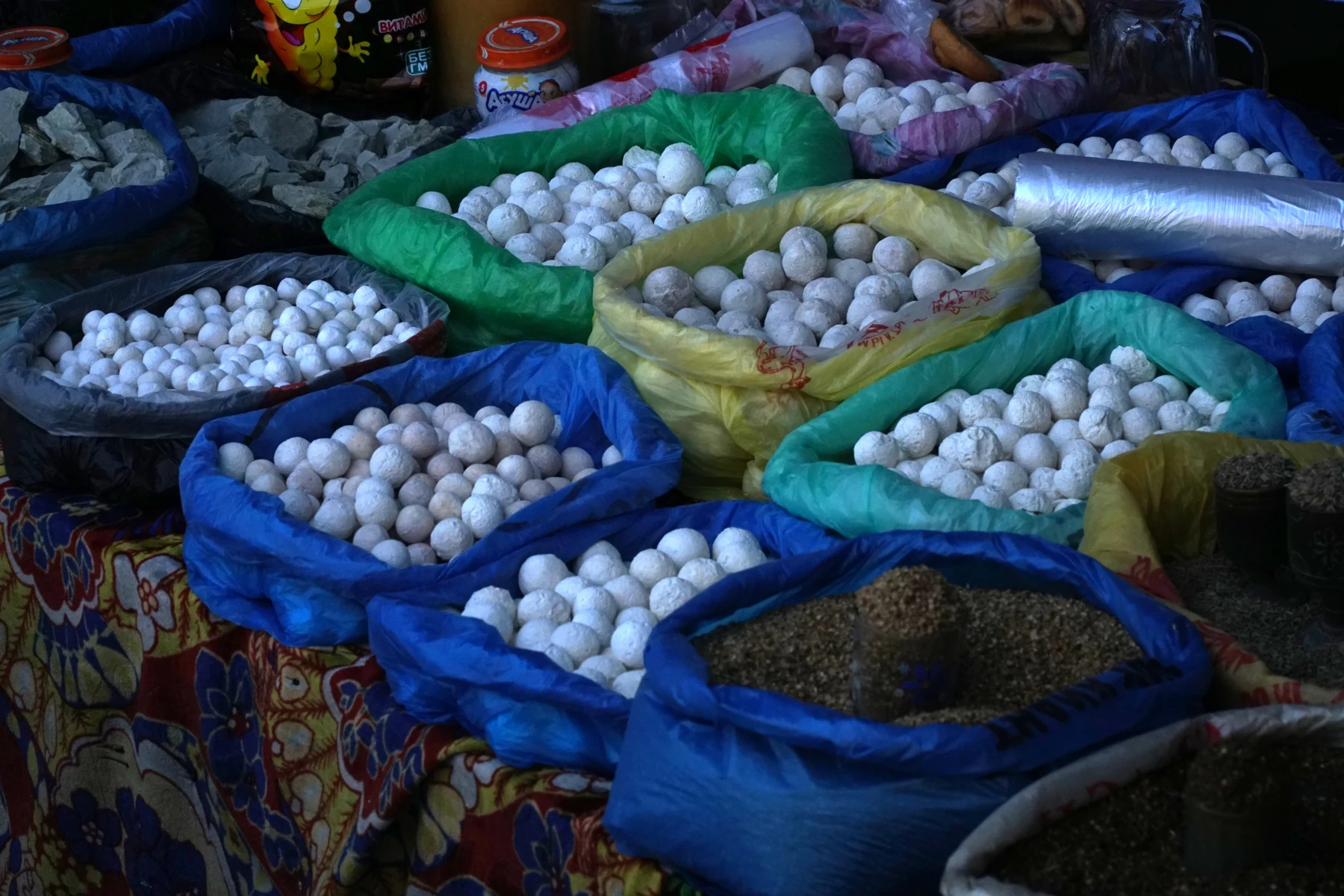
Curut is a salty, sour, dried dairy product. In Kyrgyzstan you can also meet him as a small ball and in other forms; the very hard version is worth tasting in small pieces. The dried yogurt is a good first explanation, but between the glass on the shelf and the white ball on the market, some things still happen. Concentration, salting, moulding, drying. It's up to them what ends up in your mouth.
I was so interested in this trip to Kyrgyz, my son and I started at home. We squeezed Greek yogurt through the fabric with a potato ball, formed bullets, and then put them in a soda machine. The final result was matt, chalk, but it seemed softer and more subtle to me than the earlier-tasted Kyrgyz version. It has already appeared that behind the word "kurut" there is not a single precise texture.
First the whey drains, then the balls dry
One of the bases of the Kyrgyz production is the curd: a dense mass obtained from fermented milk by removing part of whey. In other words, it takes a filtered yogurt or a thick overlay milk closer to it than a sliced block of cheese. Bakers can be used on their own, which can make dried curu.
The study by the Trakya University Journal of Natural Sciences examines the processing of the kirgiz shingles. The description also shows the dripping of whey and manual moulding: balls or cylinders are made. This is a useful difference because drying does not begin with a dilute liquid. First, we need to put together the material that can be taken and formed at all.
The report on the drying research of Biskeki American University of Central Asia also deals with the drying of salted sour milk paste in free air and drying equipment. Thus, the appearance of the assortment in itself is not a break-up with an exclusive tradition that is unchanged. Curut is still a food that is being processed by researchers and manufacturers.
I'm caught by the part of the process where the canalable mass becomes a tangible object. It can be formed for a while. And then the surface becomes less and less dry, and the same raw material asks for a very different move from man to man.


What taste do you expect from the first bite?
In the classic salty version, sour cream and firm salinity. The consistency may be dry, cartilage, chalk; a very hard ball is a different experience than a less dehydrated piece. Based on the shape, it's hard to get an exact match. In the market picture, there are bullets of different sizes and surfaces, but the photograph does not tell either the salt content or the internal hardness.
At first, I'd buy a small quantity and ask how hard it is or which is the less salty version. When you try it, a small piece is enough to see what you think of it. You don't have to use the whole bullet to prove your openness.
Travel reports are quite different. Brooke Schomeman is writing in Travel Yourself's guest article about the hard-to-like first taste. Uli on the Aika & Uli blog about how she didn't like him for a long time, but later she loved him, especially the smoked version. These are personal tastes. Neither is a measure of how a Hungarian traveller should react.
What I like about food like this is that they don't get much help with a well-written enthusiasm. Just because a meal is interesting doesn't automatically make it delicious for you. And if you don't like it the first time, it might still be interesting how the milk got to this chin.
A snack and a cooking ingredient
Kurut can also be eaten on its own, but it can also be used by loosening it up with water or working in food. Folkways' Central Asian accounts also refer to it as a raw material for drinks and soups. Thus, the same dried milk product has two very different roles: you taste it as a small piece or return some fluids to it.
That difference also counts as a traveler. When someone gives you a hard piece, it's worth asking how they use it. Maybe that's just how he likes it. Other times, you look at the ingredients of a dish, and eating from a bag is just one option.
I'd be careful with names. The Kazah kurt, the kirgiz kuru and the related names used in other countries explain but do not promise the same recipe. The author of Folkways, for example, presented a sweet version in Kazakhstan. It is therefore too early to even deal with the product family from one taste.
Our home experiment with a potato ricer
We used greasy Greek yogurt for our version. The potato powder lined with textille was used to squeeze out part of the whey mechanically. After the moulding and drying, we got balls that were left with matts, and their taste became more full to me, more cheese than I expected from yogurt.
I can tell you this as my own taste experience. I can no longer assign without weighing the exact difference between the fat content, which is the pressing and which is the drying. We've changed a lot at the same time. Besides a potato ball, there's an easy way to explain it.
In my former position, I was too sure about sustainability. There was no evidence of shelf-life at room temperature for the home dose. The vacuum packaging itself does not result in a multi-annual safe storage. A pleasant taste and dry touch is not such a test.
Therefore, this test should not be passed as a long-term storage prescription. Food preservation guides also treat drying, packaging and storage conditions separately. For the purchased product, you have to look at the terms of the manufacturer; for our own experiment, I do not post an expiry date that has not been verified.
Not entirely unfamiliar in Hungarian either
Kurut isn't just written by foreign travelers. Sándor Cíki presents the wider family of dried sour dairy products on the Food & Wine side from the Armenian churut in Transylvania. And Júlia Bartha's ethnographic study refers to a technological parallel between the boiler and the Kyrgyz Kuru, as well as the hordes of Hortobágy.
They're good handholds, but they don't match all the recipes, and they don't actually prove any straight stories of origin. It is quite interesting for me to have a specific joint task of making milk into food with a different water content, consistency and use. Compared to this, the name "nimád" is a miracle dish that says little.
If you see white balls on the market in Kyrgyzstan, the Kuru can be a good start. Then come the more useful questions: what this batch is made of, how salty it is, how hard it is, and how it is eaten by those who sell it. I'll just have a little piece first.
Sources and verification
Source verification: Personal tasting and external source of fact are separate layers.
- Iskakova and Smanalieva: Determination of flow and viscoelastic properties of the Kyrgyz ethnic food Süzmö - 2021; distinction between curut and curut, removal of whey and moulding. The measurement results of the study are not generalized for the composition of the market curut.
- American University of Central Asia: AUCA Advances Solar Drying Research - 23 January 2018; salted, concentrated milk pastes, outdoor and furniture drying. It's not a home preservation recipe.
- Brooke Schomeman: Meet Kurut, the Kyrgyz Snack Food - Travel guest article of 2012; personal tasting and different reading reactions. It's not a representative taste study.
- Uli: Kurt - getrocknete und salzige Quarkbällchen - 18 September 2016; personal report and smoked version. The author's nutritional conclusions are not being taken over.
- Folkways: Central Asian Cultural Discovery - 16 November 2014; self-consumption of snacks, beverages and soup, observation of a sweet version of Kazakhstan.
- Sándor Cíki: Creating Churut - Armenian angizabur soup - 15 April 2023; Hungarian gastronomic background. Your initial assumption and your home fermentation recipe are not generalized.
- JULlET Bartha: Eastern elements of the popular culture of the Kunal - The technical parallel between Kurut and Dödödögye; it is not evidence of a straight line of origin.
- Food Standards Agency: Vacuum packaging - The professional guide for refrigerated, vacuum-packed foods. The packaging itself is not a general safety guarantee; the time limits contained therein are not applied to kurut.
- National Center for Home Food Preparation: Packaging and Storing Dried Foods - The importance of regression and storage conditions. The storage time for fruit and vegetables is not curut- shelf-life.
Checked: October 21, 2026 The Greek yogurt homemade experiment comes from Henrik's former post; today's deliberations are new copyright. We have corrected the earlier unproven long shelf life promise. We do not provide a home preservation recipe or general nutritional value. The photos are external authors' documents, not Henrik's pictures.