
Rom-bus, hoop above it, metal ends widening on the edges. The shape of the Agadez cross is easy to remember. Your report is no longer clear. The medallion connected to Niger and Tuareg jewelry culture is also interpreted as a protective amulet, a symbol of local connection and simply a beautiful jewel. There is not one way to decipher it, valid for all ages and times.
The first thing I'm interested in is the object. How does the hoop meet the destroyer, what is the hole for, why are its edges so pronounced? Then, of course, the stories come. Four bursts, love messages, Dad's trip. A medallion this size has a surprising amount of explaining to do.


A cross shape does not necessarily mean a Christian symbol
The name can easily start a European reading: we see a cross, and we are looking for a religious relationship. However, the presentation of the Pitt Rivers Museum does not directly link the Agadez cross to Christianity or Islam. It refers to a protective role as a belief in the medallion. [1]
The object could be amulet without carrying the meaning of the cross we know. And just because a museum records a belief connected to it doesn't mean we can find out the personal explanation of every maker and every keeper.
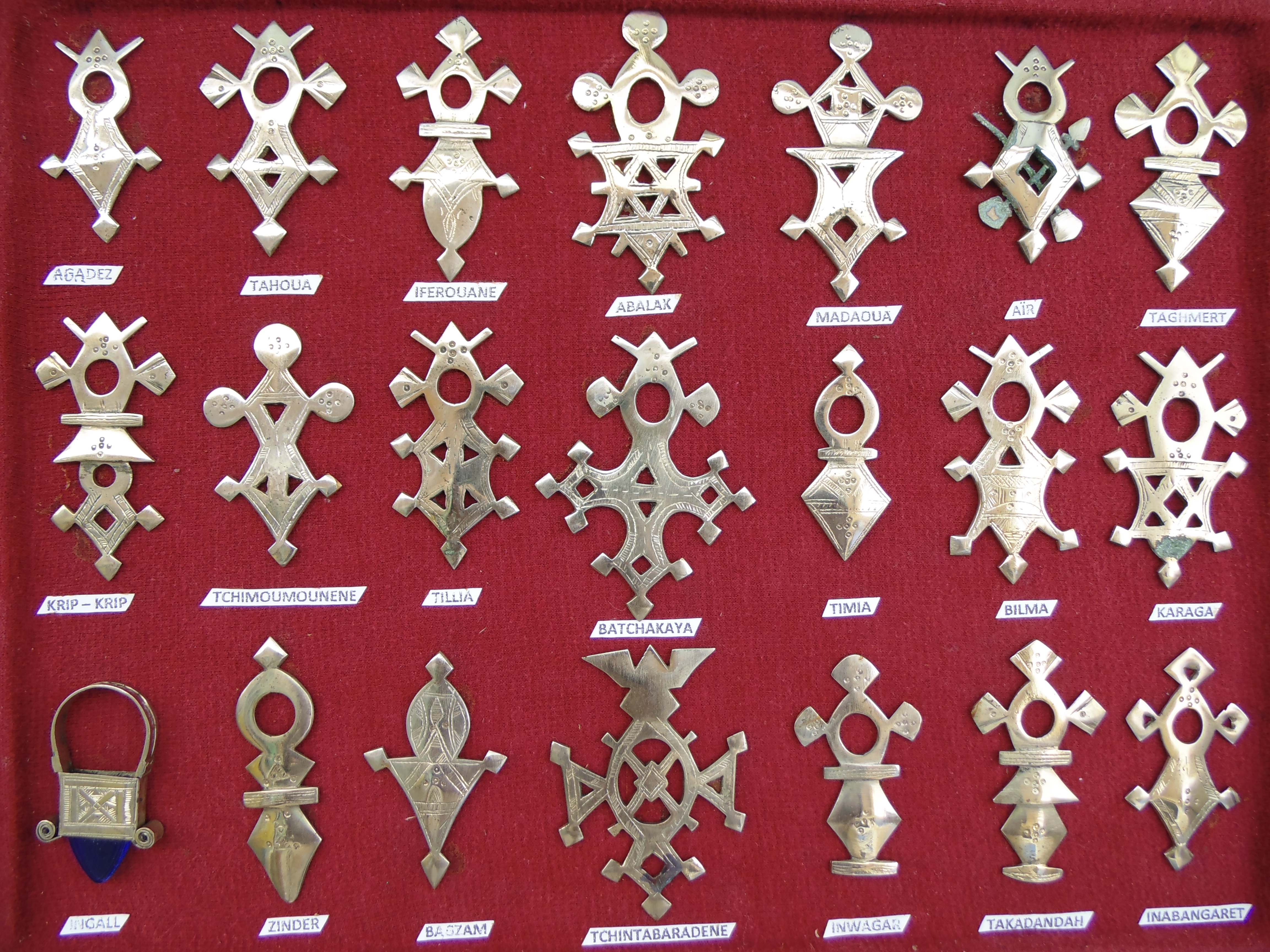
The Agadez form is also part of a larger jewelry family. Among the Niger crosses we can find variations linked to settlements: Tahoua, Zinder, Timia or Iféouane are also displayed next to them. The Spurlock Museum presents twenty-one samples in this context. [2] However, roll-call and sequencing do not mean that all pieces were created at the same time with the same role.
A comparison of shapes is worth the attention. One medallion is solid, the other is broken; elsewhere the ratio of rings changes, the middle part or the shape of the protruding ends. If all we say is "tuareg cross," we're just missing these differences.

First wax, then metal
Mohamed Ahnou agadez silversmith presents the preparation with a series of images on his own side. The form is first made up of wax. This is surrounded by clay, then when heated, the wax leaves and they pour silver melted into the cavity. To free the frozen piece, they break the shape. This is the lost waxy pour. [3]
The job isn't done yet. In Ahnou's presentation, there is a hammer, file, sand, polishing and decoration. Behind the pure contour of the finished object, there are far more operations than the fact that someone poured metal into a hole.
For me, this is a more tangible entry than starting with the medallion's summary of the universe. The wax still has a ratio to shape. The metal has another tool working on it. The inner edge of the ring, the corner of the diamond, the intersection of the engraved line is all a separate task. You can see these even if you don't come to an agreement to decipher the symbols.
Four compass points and a love story
On Ahnou's side, the explanation is that the father gives his son the cross on the threshold of adulthood, the points of which mark the four directions of the world. [4] It's a nice story: it links the possibility of departure to a removable object. But the history of the story and the historical validity of the custom are two separate issues.
Audrey Boucksom's art historian in 2017 is asking a very unpleasant question right here. It collects reports of the pendant to men, then adds early photographic and written data that document female wearer. It suggests that the story of the jewel from father to son could have been shaped by Western expectations. This is research hypothesis, not the final rebuttal of every local narrative. [5]
In other versions, jewelry is a love message. The Niger Le Sahel tells the story of a local historian named Adamou Aboubacar: the hard-to-reach princess is conveyed by an object made by a fifth. [6] It's worth reading as an original sentence. The fact that the story has been ordered for centuries does not make it an established workshop record.
I don't want to just sweep any of them. A story related to an object is cultural data in itself: someone talks about it that way, that's what they think is important, that's what they pass on. The claim slips when it becomes unnoticed that every Tuareg man always meant exactly that.
How did it become a symbol of the Sahara?
According to Bourksom's research, the international reputation of the medallion was transformed by the use of French military badges and the work of craftsmen adapted to foreign demand. The five-year-olds were active in this: they adapted their products to new customers and uses. [5]
It would be easy to conclude too quickly that the whole thing would then be tourists. But a new customer of an older object doesn't erase the knowledge of making. Just like the new use doesn't automatically prove the ancient story. You can set too much in both directions.
I think you need to be careful here with the original! Original what? Old family play? Mai, locally made jewelry? A version of a known form made in another country? That's three separate questions, and each one needs a different kind of proof. By recognizing the shape of the pendant, we haven't identified the maker, the material or his age.
What would you ask if you bought one?
I'd start with the maker. Who made it, where, what metal, and how? If the seller is the five, you can talk about the work process. If he's a merchant, then the question is, what do you know about the play's path? There is no need to assume fraud behind every uncertainty, but there is no need to replace the missing data with a good story.
We can get a more accurate answer than the report if we ask you: what does this form mean to you, and who did you learn the story about it from? At least now we know whose explanation we're hearing. You don't have to ask the seller for the whole Tuareg culture in one sentence.
However, it is worth talking about matter and age differently. The silver color is not a metal test, the dark surface is not a hatchery. If the price is based on antiques or silver content, ask for a separate certificate. Based on a photograph or form, I wouldn't say for sure what it's made of and when it was taken.
And in the meantime, he can just like it. The ratio between the circle and the diamond, the density of the decoration, the way the metal ends close the shape. If I buy one now, I'd like to look on the back. The one they don't usually show in the window.
Sources and verification notes
Control: 20 October 2026 The text is a research cultural article; it is not a documented account of Henrik's visit or purchase. The first-person parts are new copyright.
- = = sync, corrected by elderman = = @ elder _ man - the protective interpretation and discrimination from the Christian symbol recorded in his collections.
- Spurlock Museum: Beauty and Administration in the Sahara, Part 1 - family of objects, local names and craft. Because of the numbers 21 and 22 in different sources, the series is not closed and is discussed as unchanged Khan.
- Mohamed Ahnou: The making of an Agadez cross - the workshop's own work process. Photographs of the site are subject to authorisation and are therefore not included in the article.
- Mohamed Ahnou: Designs and Symbols - making an explanation, not every Tuareg community-wide certificate.
- Audrey Boucksom: Croix d (*) Agadez, croix du Niger: imaginaire occidental du monde touareg. Authority 83, 2017, 73- 88. Full magazine number in the IRD institutional store. The study is available on pages 75- 90 of the PDF and the printed page number differs. The author's conclusions are used as an interpretation, not a closed definition of origin.
- Le Sahel: Les différentes Croix du Niger - local historians and twelfths; the love story is original, unconfirmed medieval event.