
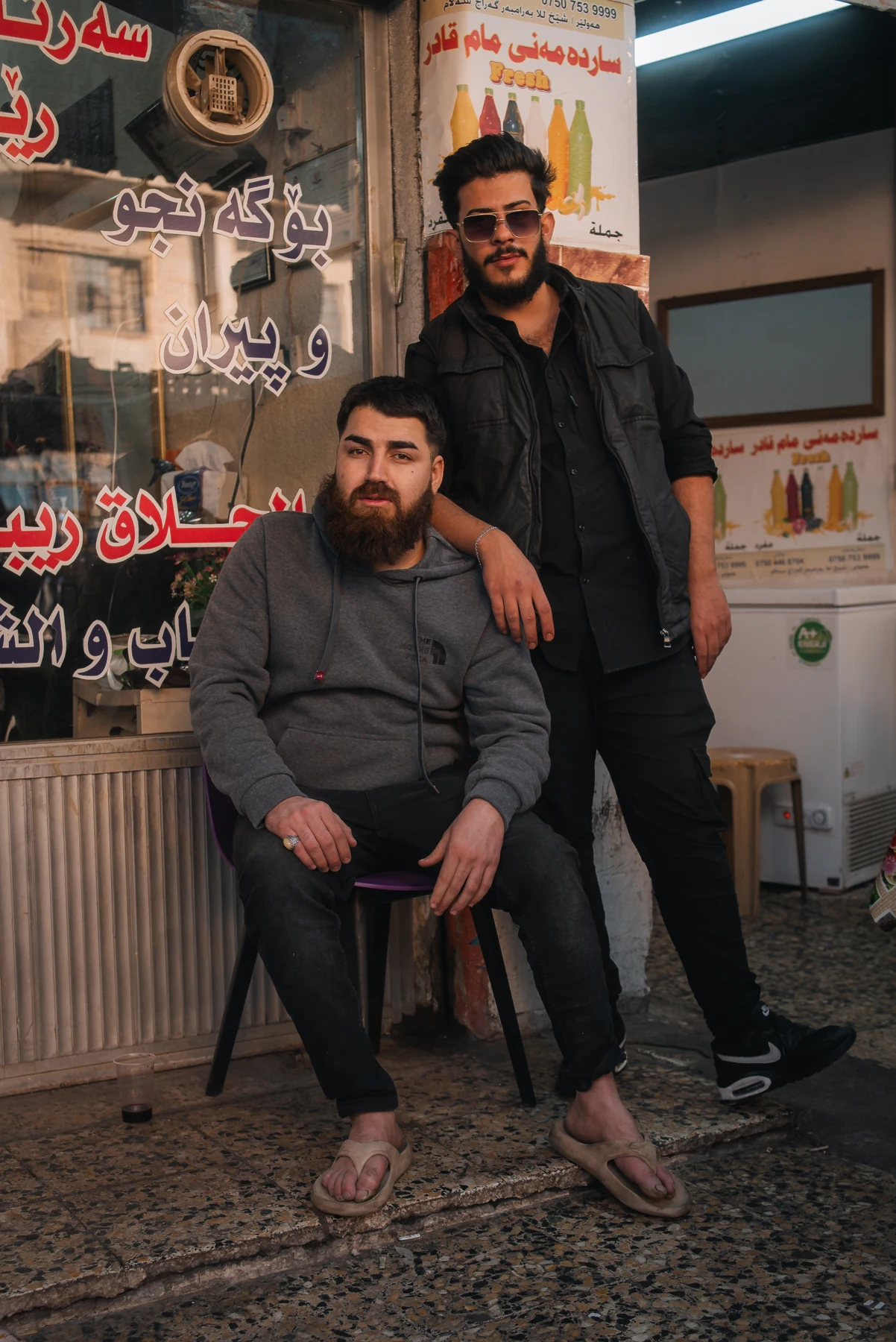
I didn't plan these portraits. They were taken in Iraqi Kurdistan, along the way, about people who asked for pictures themselves. I didn't look for a location, I didn't wait for the evening light. I had two short sentences for the circumstances: bad light, bad background. And then the pictures were taken, and now I have reason to pull them out.
When someone asks me to take a picture of him himself, the picture has something in common before I set anything up on the plane. He wants it to happen, too. That doesn't mean it's a bad photo, of course. The encounter alone does not solve the composition. But it gives me a starting point that I can't buy with any lens: the other person is already in the situation.
Suddenly I'm on the other side of the request.
It's easy to think about street portraits as if everything was the photographer's decision. I see someone, I care about his face, I want a picture of him. In my head, I'm pretty much recording before I know if anyone's in the mood for anything. He's entitled to take care of something else. Like his life.
The request came from the other side. This requires a different kind of attention. I don't need to figure out how to get an imaginary picture, I need to figure out what to do with the situation someone offered me. I don't know what kind of portrait he wants you to be. I don't even know what you see in me. I'm just saying that you want me to take a picture.
I wrote about the show: they didn't ask for pictures because I was a photographer, but because I was there. This is still a matter of interest to me today. It wasn't some professional authority that created the situation. There was a man passing by who could ask for a picture. The rest has been played by two or more of us.
I'm also interested in such a request that the character has his own idea of himself. I might like the face turning, but he wants to look straight into the machine. I might take a picture of her alone, and she's on someone's side. Not necessarily my first idea is the most important thing in the situation. It is sometimes particularly useful to keep this in mind as a photographer.
Hands make portraits too
In the picture of the two men, one sits behind him and puts his hand on his shoulder. In addition to sunglasses, dark clothes and beards, this hand is the one that sets up the portrait. It also physically connects the two figures. There are inscriptions on the glass behind them, drinking pictures next to them, fluorescent lamps above them. There's a lot going on for only two people looking at the camera.
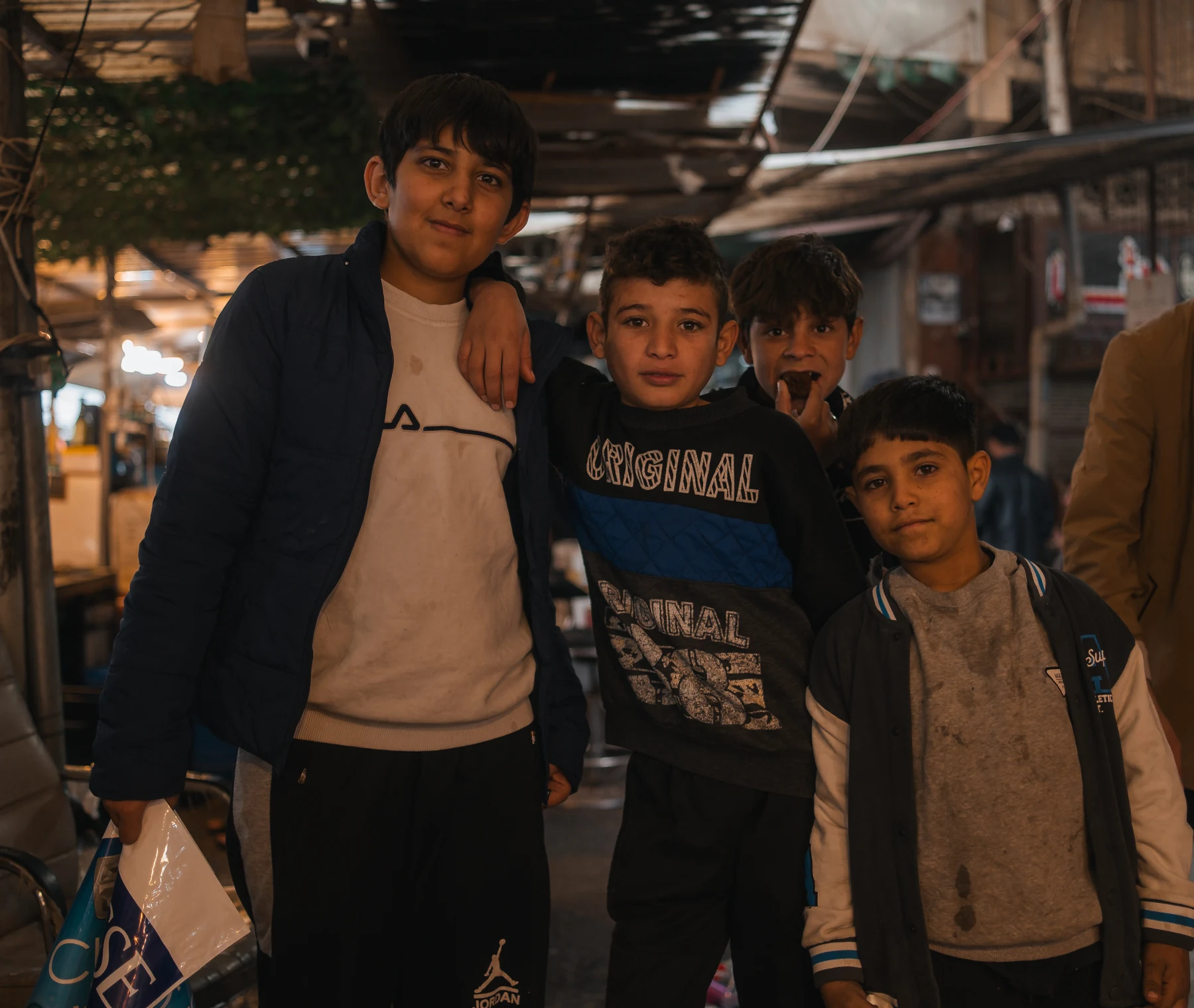
The kids' group photo has their hands on it again. A shoulder arm pulls the figures closer together, while the eyes and faces remain different. They're not in the same picture. The group stands together, but not everyone dissolves in one common expression.
These are the details I like to watch in a portrait. How someone sits next to the other, how much space remains between them, where their body turns. Sometimes a hand does more for a picture than a particularly spectacular background. In the meantime, I don't want to say any more than I can see: from the hand on the shoulder, I can't tell you what kind of relationship they have with each other.
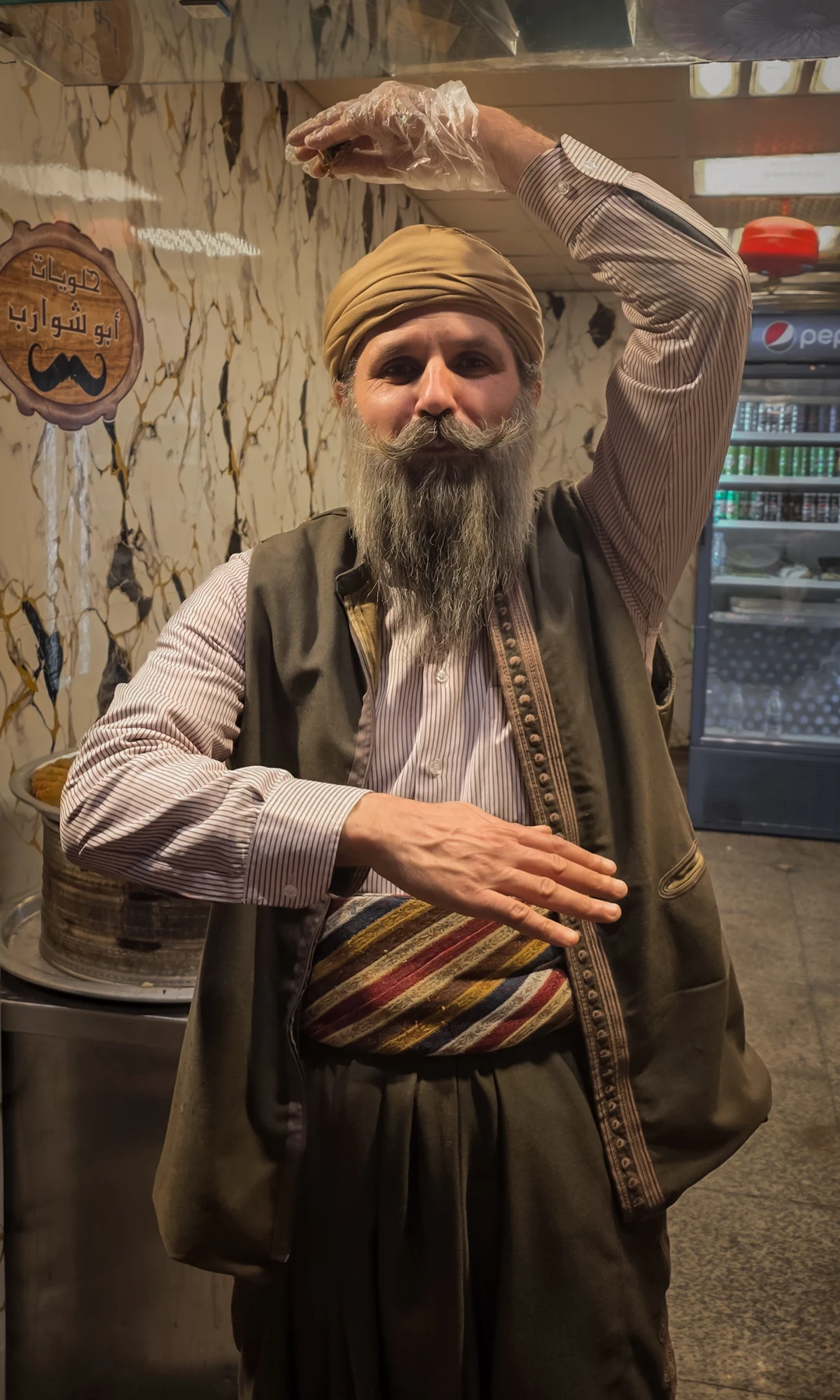
The raised arm of the bearded man in another picture transforms the whole composition. The gesture takes attention over his head, the other hand stays down, between the two is the face and the vest. The gloves, striped shirt, the wall pattern and the backdoor liquor fridge are all involved. It wouldn't be the same portrait if I just left the face.
The street is not a studio backdrop
As a photographer, it's easy to wish an environment for a face that does its job nicely. Separation, no distractions, dark or light in the right place. The inner space of the street, the shop or a barber, on the other hand, does not necessarily share my compositional ideas. He has his own subtitles, objects and lights.
In these pictures, the background is not always calm. It's got a pattern, advertising, wire, bright surface, a stronger spot. The inscriptions behind the two men, for example, require attention. If I could make them all disappear with a smaller cut, it would be easier to look at the faces. However, there would be less of the place where the image was created.
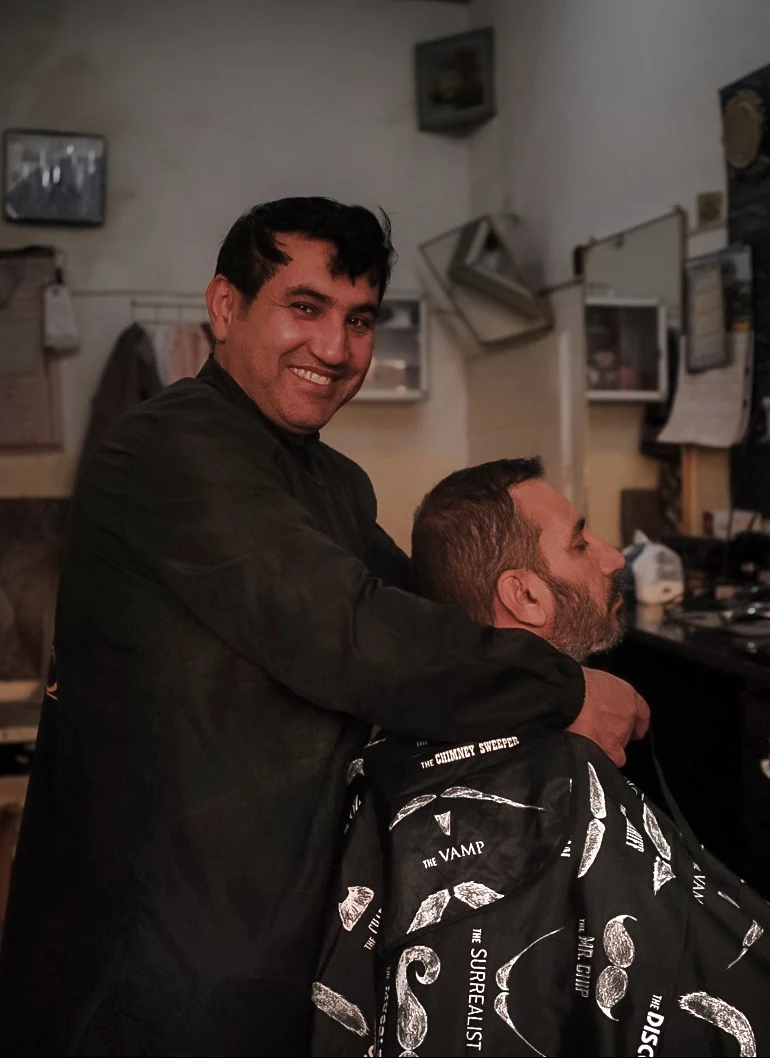
The picture at the barber's makes the environment work differently. The mirror, the pictures on the wall and the pattern cover together give the inner space. The smile of the man turning towards the machine and the different direction of the figure in the chair will be placed from this environment. In front of a one-color background, there would be a lot less questions in the picture. There may be less distractions. But for me, that's the kind of alignment that's interesting.
That's why sometimes a judgment is too quick. Of course, there is a detail that really just takes the picture apart. But not everything that doesn't rush into the idea of a pure portrait is unnecessary. The environment needs to be looked at as well as the face. First you decide what to add, and then you wish you weren't there.
A good story doesn’t excuse poor light
The importance of meeting may easily be exempted from any technical error. It was nice, so it's a good picture. I'd argue with that. A face could be lost in the shadows, and a clear detail could take attention from it, even if it was personally important.
The viewer sees the finished footage. My memory of him is not automatically given to you, nor is it your job to feel the things that make me feel something. The image has to work on its own. If I can only keep you alive with a long explanation, I'd like to see if I really want to show you the photograph or tell you about the meeting.
For example, there are clearer details in the picture of children than faces. Space is dense, light is not even. Yet I return to the faces, because their closeness and different eyes keep the group together. I do not want to say this in retrospect as if it were the result of a premeditated lighting plan. In the finished picture, I can see why it works for me.
In a situation like this, I'd be looking for a little change that still fits. One step to the side, another image cut, a little different direction. However, there is a limit to repair. If I manage the cast as long as all the details are correct, the ease of the initial initiative could easily disappear. There will be a more formal picture and some people who would like to go on.
I didn't take pictures of a whole country.
These portraits are made in Iraqi Kurdistan. It's part of their story, but it's not a reading manual for faces. They don't tell us what the characters think about the world, what they care about or how they relate to the place where they live. Their clothes and surroundings are visible. Not a whole life story.
I don't want to take a few pictures of the people who live there. In these meetings, there was initiative, intimacy, opportunity to take pictures. I can tell you that much. It would be a much bigger statement now that I know something about everyone based on my own brief presence. For a traveller such a conclusion is convenient, but for the man in the picture it is rather narrow.
I'm more interested if someone can stay in the picture for a specific person. I don't need to make it a symbol of hospitality, difficult fate or an entire culture. If I don't know his story, I don't need to figure it out for him. Sometimes the most accurate outline of a portrait is if I don't try to explain everything about it.
Attention continues after the photograph
The image request is a clear starting point, but the later fate of the photograph will not be resolved by itself. It is different from a video shown on a display, a sent portrait and a picture in a public article. As a editor, I also look at what kind of text someone is going to get and what the story I'm going to make part of.
For example, I do not want a great sentence written by me to act as if it were the thought of the man in the picture. My interpretation is mine. His face doesn't prove it. In the same way, it does not follow from the short proximity during photography that we have gotten to know each other thoroughly. It might be important to meet someone because it won't take long.
In the end, I will have two questions in mind for the selection. Is this picture important to me? And is there anything in it that works without my own memory? Maybe I can only answer yes to the first one. I can still keep it. Not all personally important photos need to do the same job in front of others.
At these portraits, next to the faces, I return to gestures again. To the hand on the shoulder, to the raised arm, to how more people can fit in a picture. I can stay around the light and the background with my photographic excuses. But I don't want the other man's initiative until there's nothing left of it.
Beyond My World · Inner Circle
I'd like to tell you about the next trip.
New roads, tours and expeditions on my Messenger channel. One-way channel, not group chat: I'm the only one who writes when there's a new option.