
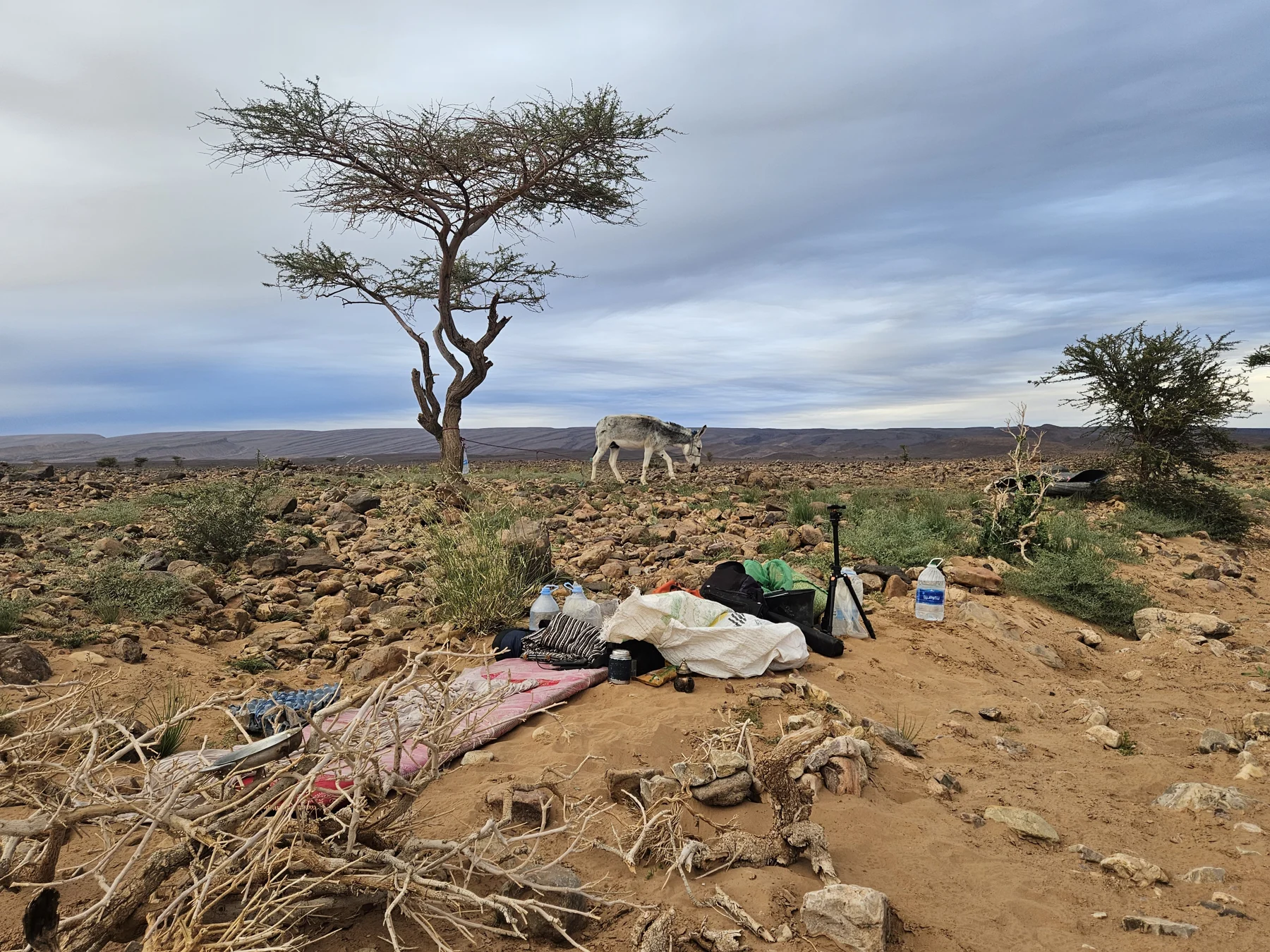
In my entry about the third day, I was already carefully counting how much each of us carried. Yiddir had thirty kilograms, I had twenty. I had taken my fifteen-kilogram backpack back from him and was also carrying a five-litre bottle of water in my hand. He kept moving steadily alongside the road, while I slowed down. “If we carry on like this, tomorrow I’ll be the donkey and he’ll be Henrik — but then I’ll definitely throw myself into the sand and roll around too,” I wrote, still hoping the role reversal would not become complete.
I left Zagora in December 2024 for the dunes of Erg Chegaga, through the mountains of AntiAtlas. According to my own follow-up, in ten days, we have travelled about a hundred and sixty kilometers, along with all the skyscrapers and photographers. I slept under the sky the whole time. I've been looking at maps and satellite images for months before the road, trying to figure out which valley leads on, where I can find water, and where to get through the mountains. In the end, Yiddir determined how much he had eaten, how much he had endured, and whether he was willing to cross the next water.
In the first days, I wanted to go faster.
The original plan was a three-hundred-kilometre walk. A donkey would carry the water and food, and I imagined starting from the last village before the desert. But I could not arrange transport for the animal, so we set off from Zagora instead. That added a mountain crossing to the journey, through terrain I knew much less well than the area around the dunes.
In my post of departure, I can explain peacefully why we are moving slowly: Yiddir is a little drunk at every bush, and I am leaning down for every second stone to examine it closely. I wouldn't be able to share the responsibility fairly today. He cared about vegetation, I cared about mineralogy, and one of us kept finding something he thought was worth stopping for.
However, it was soon found that it was difficult to move forward after ten or twelve kilometres. I wrote under a acacia tree that the foot of the mountain will only be reached for the next night, and there I would like to spend an entire day feeding it. Then I even listed my supplies: one kilo of rice, one kilo of flour, forty eggs, fourteen smaller bread and vegetables. I kept counting the distance in my head, but the next day's plan had to fit Yiddir in to rest and eat properly.
Before the third night, we were attacked by dogs. According to my age report, he was more upset than I was. After grazing this morning, I tried to dictate a faster pace, but after about two hours of walking, he started scratching the sand, and then he went to bed with the equipment on his back. I took everything off him, helped him up, and started feeding again. There was no green vegetation nearby, just a dry disease.
Meanwhile, the wind blew, the sand covered the electronics equipment, and I couldn't find any wood to tie it to. I took the rope with one hand, tried to put back about 50 kilos of stuff so that it would be evenly distributed and properly fastened. Two eggs lost in the operation. At this point, I took the backpack and the water, and then we went on a road between farms. Yiddir came by me at a good pace, and I began to sense the difference between the equipment that was designed and the equipment on my shoulders.
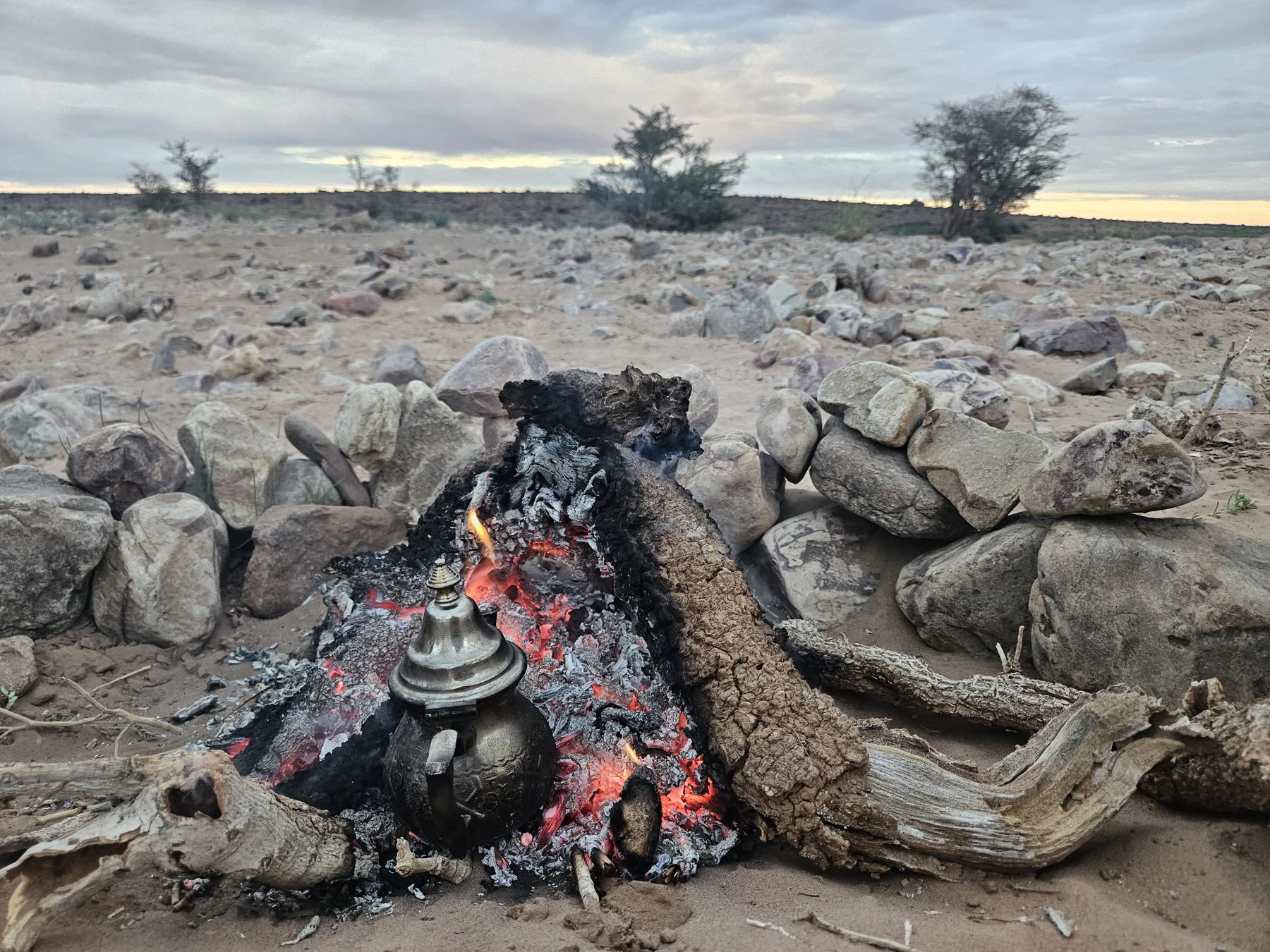
I asked him for green plants and water on one of the farms. We camped two kilometers away, where I found dry acacia wood, baked omelettes with peppers and beef biltons, then made tea with honey. During the rising full moon, I've already written that my mattress would now be valued at the Booking 10. It was the same mattress, but that night there was fire, water and hot food, and the next day I was planning a break. This made the accommodation look different.
In the mountains you had to look at the landscape differently.
The report on the sixth day has already passed a mountain line, but on the other side there are more mountains waiting. I figure we'll have about two more days of walking before we get out of them. The GPS doesn't update me properly, I use a compass, and when looking for the campsite, I also have to check if I can find something to tie Yiddir to overnight.
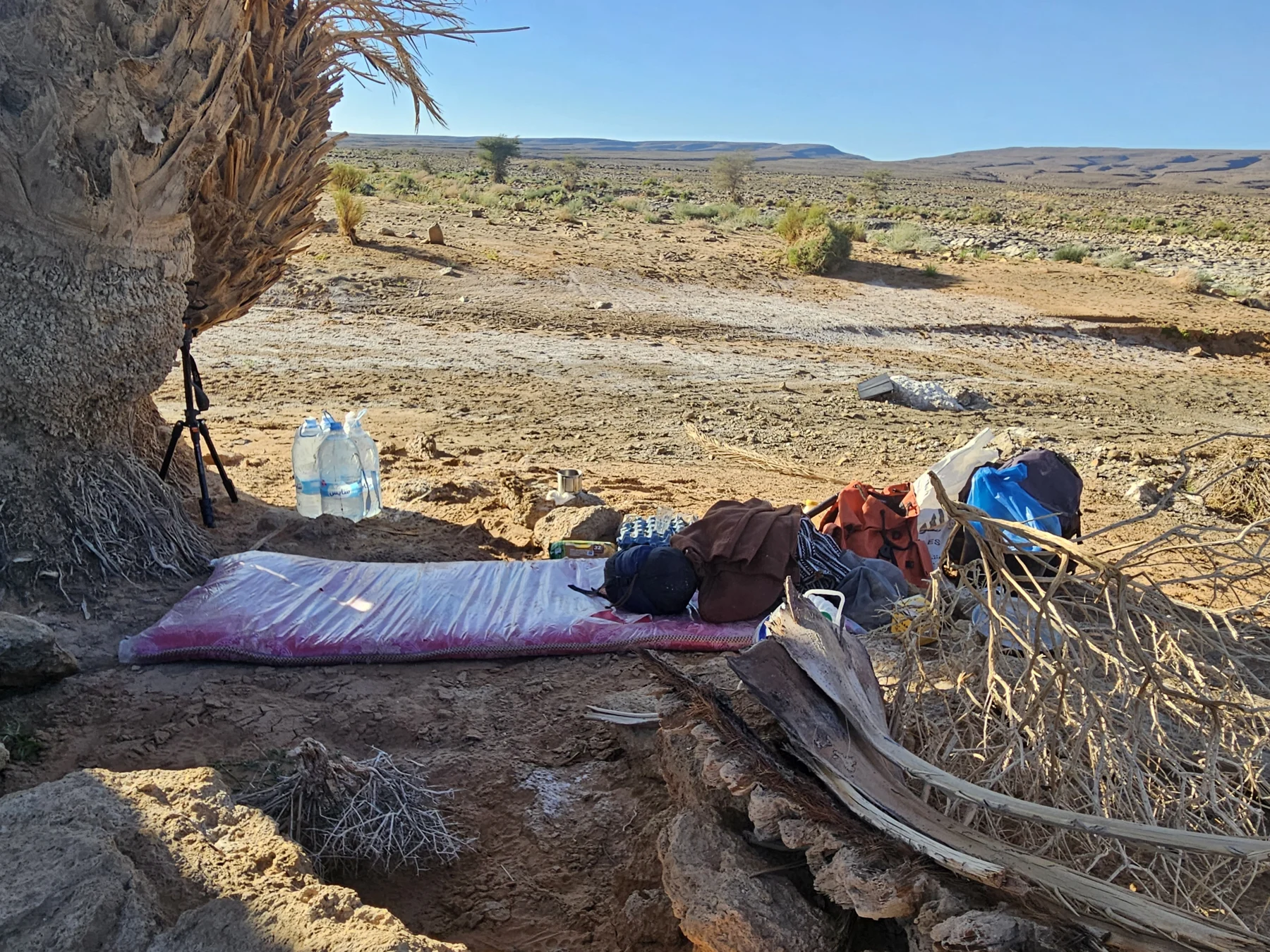
Finally, we descended into a valley where there were dates, water and grazing vegetation. In the post, I called it microasis. The value of a place like this on the way was quite easy to determine: he could have eaten, I found fuel, and we didn't have to search for any more by night. After sundown, I baked four eggs and watched Milky Way for hours. Later, I woke up cold; it was early this morning.
In my entries, the beautiful and unpleasant parts are often included in the same paragraph. After the starry sky comes the cold, and in the morning the feeding and packing. By this time, I'll write more about Yiddir: he'll chew on my dress while I'm playing, bite me, stick his head between my things. On the sixth day, I also find out that at first I instinctively treated him like a child, but now I'm starting to treat him as a partner.
At the same time, I wrote that in the first few days we poisoned each other, he didn't want me to overdrive him, and I didn't want him to think I was stupid. That was my reading at the time. I know my own impatience and insecurity in him quite well; I know much less about what he thought of me. However, the events of the next few days have also shown me that it was not always worth sticking to the direction or pace I had imagined.
On the seventh day, following a river valley, we began to find ourselves in more and more difficult terrain. The canyon was deepened, and after the previous rains there was water left in the bed. At a small crossing, Yiddir jumped, came in with his legs falling apart, and while I was helping him, the equipment fell into the water. I took out the bags, washed what I had to do, and then I went ahead to watch the sequel. I suddenly found a deep canyon and a waterfall, but I couldn't see where we could go.
I turned back to him. Later, a man arrived with four camels and showed me the right direction; without him I would have tried on the other shore. The deeper section was bypassed from the side, followed by pools full of water, frogs, insects and purple flowers. There was wood for the fire and food for Yiddir. I made my bed before a small rock drop, where the fire heated the stones. That night, everything we needed came together again, although I still didn't know exactly how many mountains were ahead of us.
Twenty kilometres following a footprint
The next day, I could no longer match the directions from the man arriving with camels to what I saw ahead. I began following the print of a size-thirty-nine shoe with a striped sole. It disappeared over the rocks and reappeared in dustier patches; according to my entry, it helped me find the way for about twenty kilometres. I knew nothing about its wearer, but they had passed through before me and left enough traces for me to pick up the route from time to time.
This has become one of the hardest days. It had to be crossed by stone, between 30 and 50 centimeters, between which there were puddles and deep depths filled with water. And in the camels, it turns out that the height of the raspberry counts. The higher burden of the camel could have been found where Yiddir's lower hanging bags were stuck on the rocks. So either you had to squeeze it, or you had to pack it, take the gear, and put it all back on again.
It started raining, and I wanted to get out of the mountains more and more. Yiddir didn't want to cross certain waters, sometimes he stopped at a puddle where I couldn't understand his resistance. If there was a chance, I'd let him find another way. I used to pull it by force. In the text of your age, it's in the same way that I started treating you as a partner. In addition to the losing stock, the weather and my own fatigue, I have not always been able to decide patiently when to wait for it and when to try to move on.
I have little energy left for photography in this section. The 360-degree camera on my shoulder was more useful than pulling out the rest of the equipment. Most of the pictures attached to the eighth day post were taken after the most difficult part of the mountain: at the mountain leg, at a well, at the camp, and at sunrise the next day. When I look back at the material now, I have to take that deficit into account. Most of the places that give you work are not necessarily a picture of what it was like in retrospect.
On the morning of the ninth day, I was getting ready slower. I wanted to rest, I carried the backpack, and because of the running out of water and food, the rest of the bags got easier. At about eleven o'clock in the morning, Yiddir began to urge me to leave: he pulled my dress on my backpack several times. He took off on the camel path at such a pace that I almost had to jog behind him, and I tried to stop him. A few days ago, I wanted to move faster at all costs.
One more stop before the dunes
The dunes of the Erg Chegaga finally appeared on the other side of a green plain. I wrote about relief: I felt the sandy terrain and the wells more familiar than the dry mountain region. I was targeting the biggest dunes. After a while, the path went on in an open, quarry area, but we didn't get to them that day.
Because of the strong wind and the sandstorm, we camped about three and a half kilometers ahead. I went to bed behind Yiddir's raspberry, on the side more protected from the wind. Around 10: 00 p.m., the weather was quiet, and I found a fire, and the fire burned until 3: 00 in the morning. After midnight, the moon came out. The goal was quite close, but our day ended there.
I'm already at Erg Chegaga on the 10th day post. I was preparing for this trip a year ago, but it was hard to place what I felt when I arrived. I entered a camp, I was back among people, and suddenly I felt more separation.
I met people on the way. I asked for help on farms, talked to a soldier, and the man with the camels gave me directions. Yet I spent most of my days with Yiddir, doing things that made the next step clear. If the raspberry didn't fit, I had to take it off. If he didn't have anything to eat, he had to look for it. By evening, we had to find water, fire and camp, and this morning it all started again.
After the arrival, there was suddenly less of them, and there was also some difficult sadness. In the later look back, I wrote about how the city was busy, so I went to a river bed looking for achada.
Beyond My World · Inner Circle
I'd like to tell you about the next trip.
New roads, tours and expeditions on my Messenger channel. One-way channel, not group chat: I'm the only one who writes when there's a new option.
It opens in a messenger.